
Two paths. Two visions. One choice about Labour’s future.
For much of its history, the Labour Party has presented itself as more than an electoral machine. At its strongest, it has claimed to be a political movement, rooted in organised labour, driven by social purpose, and animated by the idea that government could reshape society, not simply administer it. The question now is whether that instinct still exists, or whether Labour has become primarily a party of management.
It is a question sharpened by the demands of power. After years of political turbulence, there is a clear appetite among many voters for competence, stability and seriousness. Labour has sought to answer that mood, presenting itself as disciplined, pragmatic and safe. In a country fatigued by upheaval, managerial credibility has undeniable appeal.
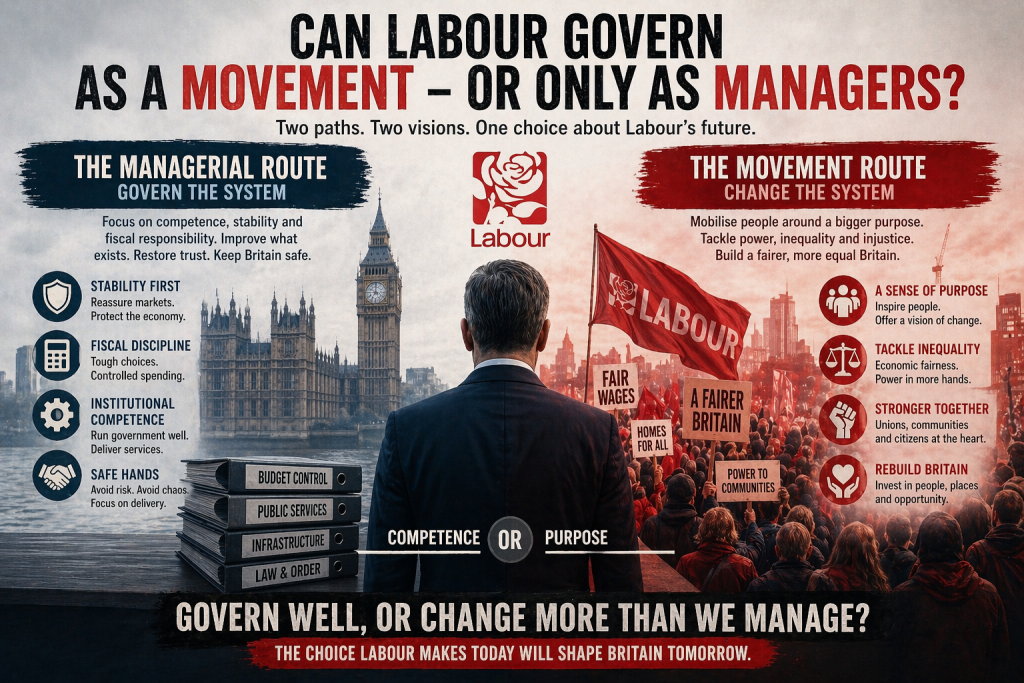
But governing competently and governing transformatively are not the same thing.
Critics argue modern Labour increasingly speaks the language of administration rather than ambition, focused on reassurance, fiscal caution and institutional trust, but less certain in articulating a broader political mission. In this view, it risks becoming a party that promises to run the existing system more effectively, rather than challenge whether the system itself is delivering.
That matters because Labour’s identity has historically rested on something larger than managerial competence. From post-war reconstruction to later reforming governments, its strongest moments have often come when it married practical government with a sense of movement, when policy felt tied to a bigger story about fairness, power and social change.
Some argue that spirit has weakened. Trade union roots carry less political weight, party structures have professionalised, and politics itself has become increasingly technocratic. In that environment, governing can begin to look less like mobilisation and more like administration.
Yet defenders of Labour’s current approach might argue the opposite: that in an age of economic constraint, institutional fragility and voter distrust, seriousness is itself a form of radicalism. Repairing public services, restoring stability and rebuilding state capacity may be less dramatic than grand ideological projects, but no less transformative.
That argument has force. But it raises another question: can management alone sustain political energy?
Movements inspire loyalty because they offer purpose, not simply competence. They ask supporters to believe in change, not just better administration. And without that deeper animating force, even capable governments can appear cautious, reactive or hollow.
This tension sits at the heart of Labour’s modern dilemma. Is it positioning itself merely to govern responsibly after disorder, or to redefine the terms of British politics?
The answer may determine not only how it governs, but what kind of governing party it becomes.
Because parties that act only as managers can win office.
But parties that govern as movements can shape eras.
And in a country wrestling with inequality, stagnation and political fatigue, the real question may be whether Britain needs competent management alone — or something more ambitious than that.