
For much of modern British history, the idea of working-class political representation seemed relatively clear. The Labour Party was not simply a party that sought working-class votes; it was born from organised labour, trade unions and a broader political movement rooted in class identity. But in today’s Britain, that relationship feels far less certain. A serious question has emerged: who, if anyone, truly speaks for the working class now?
Part of the answer lies in how profoundly the idea of class itself has changed. Industrial communities that once shaped political identity have been transformed by deindustrialisation, precarious work, service economies and regional decline. The traditional language of labour politics often feels detached from a world of gig workers, warehouse staff, carers, delivery drivers and insecure renters.
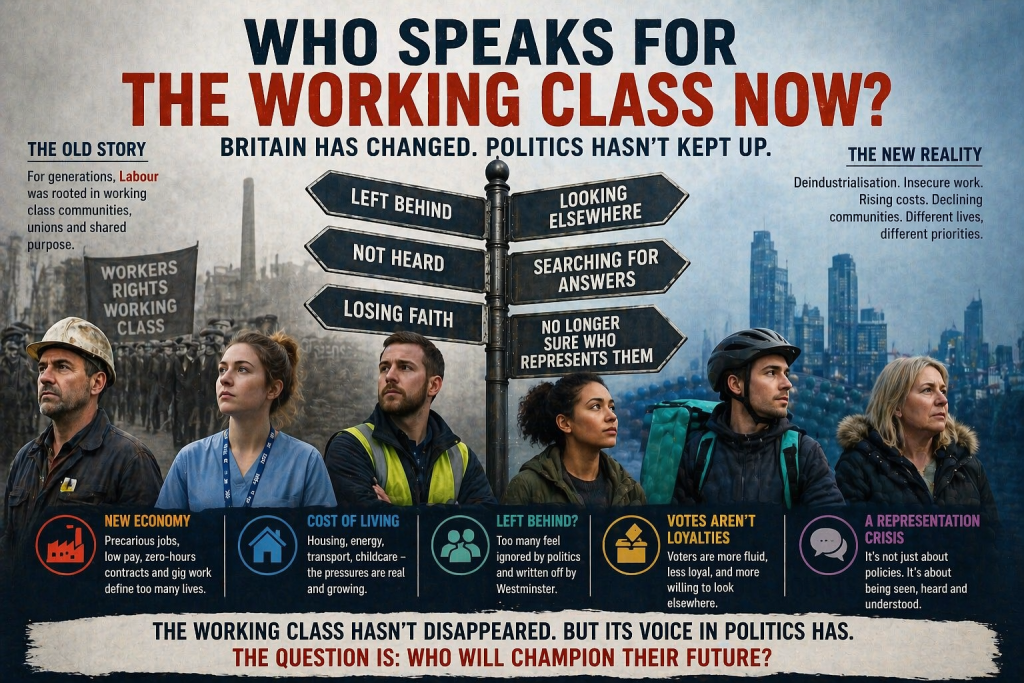
At the same time, political loyalties once thought fixed have fractured. Many working-class voters who were once seen as part of Labour’s natural base have become more volatile, moving between parties or withdrawing from politics altogether. Some have been drawn toward parties such as Reform UK, often less out of ideological alignment than from frustration with a political establishment they feel no longer sees them.
This has prompted a deeper debate over what “working-class representation” even means. Is it about economic redistribution and wages? Is it about community, identity and social order? Is it about cultural concerns often ignored by metropolitan politics? Increasingly, those questions point in different directions.
Some argue mainstream politics has redefined working people as an electoral demographic rather than a political force. Parties speak about them, court them, poll them, but do they genuinely organise around their interests? Critics suggest much of modern politics has become managerial, treating material concerns like housing, wages and public services as policy problems rather than the foundation of democratic representation.
Yet the vacuum has not gone uncontested. Trade unions have shown renewed activism in recent years. Populist movements claim to speak for those left behind. Some on both left and right are attempting to rebuild politics around place, nation and economic security. But whether these efforts amount to genuine representation or simply competing claims to it remains unresolved.
There is also an uncomfortable possibility: perhaps no single party now speaks for a working class that is itself too diverse, fragmented and politically divided to be represented in old ways. A delivery rider in London, a skilled tradesman in the Midlands and a former industrial worker in the North may share economic pressures, but not necessarily political priorities.
That may be the central challenge. The old certainties have faded, but no new consensus has replaced them.
And that matters, because when large parts of society feel politically unrepresented, the consequences go beyond elections. It shapes trust, belonging and democratic legitimacy itself.
So the question is not simply who speaks for the working class now.
It may be whether British politics still knows how to listen.