
For decades, electoral reform has hovered at the edge of British politics, periodically debated, rarely embraced, and often dismissed as a constitutional distraction. Yet as political fragmentation grows and trust in institutions remains under strain, the question is returning with greater urgency: should Britain finally move towards proportional representation?
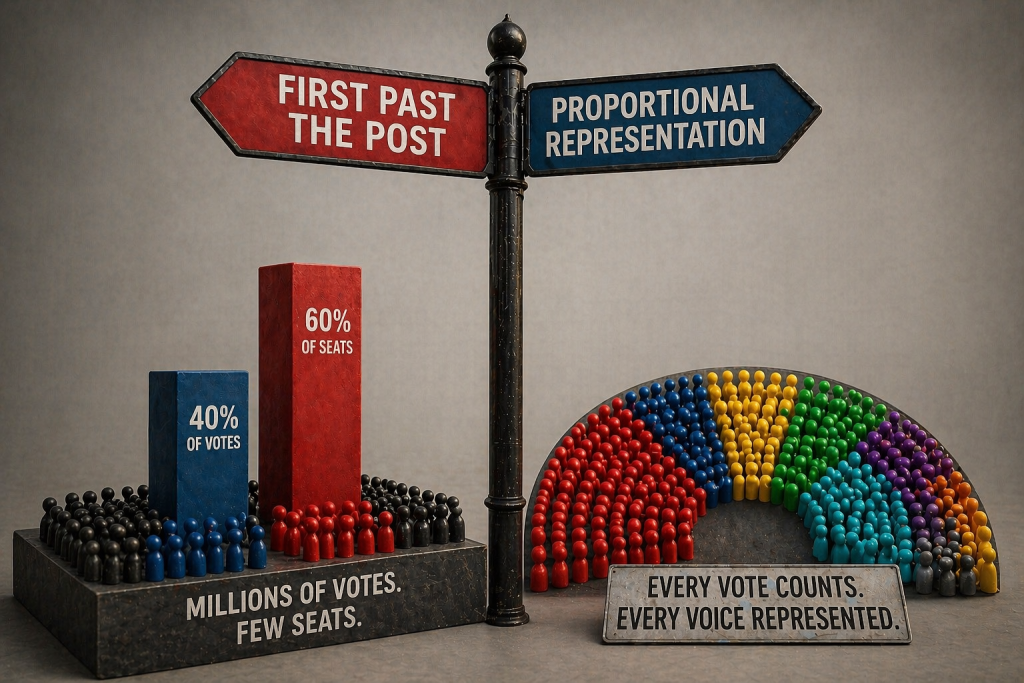
Supporters of reform argue the case begins with fairness. Under the current first-past-the-post system, governments can secure commanding parliamentary majorities on a minority of the popular vote, while smaller parties can attract millions of votes yet win only limited representation. To critics, this distorts democratic choice and leaves many voters effectively unheard.
Proportional representation, advocates argue, would better reflect how people actually vote. Parties such as the Green Party of England and Wales, Reform UK and regional movements could see representation more closely aligned with their national support. In theory, fewer votes would be “wasted,” and more citizens might feel their ballot carries weight.
There is also a broader political argument. Britain’s traditional two-party structure appears under pressure from regional divides, ideological fragmentation and declining partisan loyalty. Some believe the electoral system no longer reflects the political reality of the country. Reform, in this view, is not merely procedural, it is an adaptation to a changing democracy.
Proponents often point to stability through cooperation. While critics associate proportional systems with weak coalitions and endless bargaining, supporters counter that coalition government can encourage consensus, compromise and long-term thinking, qualities many feel have been lacking in recent British politics.
Yet the objections remain substantial. Critics argue first-past-the-post delivers something valuable: clear outcomes. It tends to produce decisive governments, direct accountability and a strong link between MPs and constituencies. Voters know who governs and who can be removed.
There is also concern that proportional systems can empower fringe movements, give smaller parties disproportionate leverage in coalition negotiations, or lead to political paralysis. For defenders of the current system, imperfect though it may be, those risks outweigh the promise of greater representational purity.
But perhaps the strongest argument for revisiting the debate is not technical but political. Electoral reform has often been treated as an abstract constitutional issue. Increasingly, it feels tied to questions of legitimacy, trust and whether British democracy still commands confidence.
The real question may not be whether proportional representation is flawless, it is not, but whether the current model remains fit for a more plural, volatile political age.
For some, reform would modernise British democracy. For others, it would destabilise it.
But as voter loyalties fragment and dissatisfaction with Westminster deepens, the debate is becoming harder to avoid. The issue is no longer simply whether proportional representation is desirable.
It may be whether Britain can afford not to consider it.